
Navigating the EU Deforestation Regulation: challenges and opportunities for sustainable coffee supply chains
Updated: Jan 21
The global agriculture commodities sector stands at a critical crossroads. The European Union Deforestation Regulation (EUDR), adopted in 2023, applies to a range of high-risk products — including cattle, cocoa, coffee, oil palm, rubber, soy and certain timber products — and marks a significant turning point for sustainability requirements in global supply chains. In this context, we focus on coffee, which represents livelihoods for millions of smallholder farmers across tropical regions. The pressure to ensure sustainability, traceability, and climate compatibility across supply chains has never been greater. While the regulation aims to reduce deforestation linked to global supply chains, its consequences reach farther than forest conservation. For producers and exporters in the Global South, particularly smallholders in Africa, Asia, and Latin America, the EUDR is both a challenge and an opportunity — a test of preparedness and a potential catalyst for more resilient, transparent, and sustainable production systems.
A new era of deforestation-free trade
The EUDR requires that commodities and products placed on the EU market are deforestation-free and produced in accordance with the laws of the country of origin. For coffee, this means that every shipment entering the EU must be traceable back to the specific plot of land where it was grown, using geolocation data and evidence that no deforestation occurred after December 2020. This represents a major shift in how global agricultural supply chains are managed. The regulation effectively moves sustainability compliance from voluntary certification schemes to mandatory legal due diligence.
All market operating companies, regardless of size, are now required to establish comprehensive systems for tracing, monitoring, and verifying production sources. However, the regulation differentiates between small and medium-sized enterprises (SMEs) and larger companies:
Reporting requirements: non-SME operators must publicly report annually on their due diligence systems and compliance actions; SMEs are exempt from this public reporting obligation.
Due diligence (DD) obligations: all operators, regardless of size, must carry out a DD before placing products on the market. SME operators can rely on an existing due diligence statement (DDS) if the products have already been verified earlier in the chain. In that case they only need to reference the DDS, not repeat the full process.
Trader requirements: non-SME traders are treated like full operators and must carry out the full DD. SME traders only need to retain and share specific supply chain information (e.g., who they bought from, DDS numbers), rather than perform full risk assessments.
Despite these differences, compliance is significantly more challenging for smallholders in producing countries. In many producing regions, landownership records are incomplete, digital infrastructure is weak, and access to monitoring tools such as satellite imagery or georeferencing technologies can be limited and has to be developed. Without suitable support, there is a risk that smaller producers will be excluded from European markets due to non-compliance, reinforcing structural inequities within global trade.
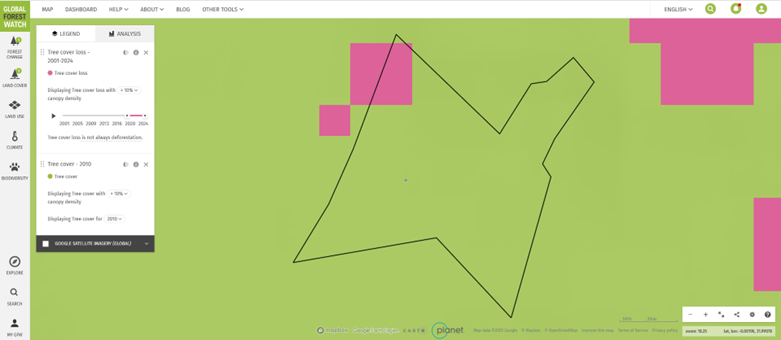
Geospatial monitoring tools such as Global Forest Watch show an area as “tree cover loss”
Uganda as an example
In Uganda, one of Africa’s main coffee producers and exporters to the EU. The country’s coffee sector is dominated by smallholder farmers cultivating small plots, often intercropped with other crops and managed under traditional shade-grown systems. While many of these practices are environmentally sustainable, not all farmers apply them consistently, and they are not systematically documented or monitored in ways that would meet EUDR traceability requirements. Moreover, the complexity of Uganda’s supply chains—where coffee from thousands of farmers passes through various supply chain actors before reaching exporters—challenges the establishment of direct traceability systems. Limited access to digital tools, lack of standardized data collection, and varying capacity across cooperatives and processors add further challenges. However, farmers and cooperatives from Uganda and similar producing countries are increasingly recognizing that compliance with the EUDR could position their coffee sectors as leaders in sustainable production. Meeting EUDR standards can help strengthen market access, attract climate finance, and particularly when combined with relevant certification schemes, enable premium payments and create new opportunities for value addition through verified sustainable products.
Digital traceability and remote sensing
A core component of EUDR compliance is the ability to demonstrate that coffee production plots are deforestation-free. Technology tools for remote sensing, satellite monitoring, and georeferenced farm mapping are emerging as key enablers of transparent and efficient verification. Developing such systems requires investment in digital infrastructure and capacity building. National coffee authorities, cooperatives, and exporters must work together — ideally in partnership with demand-side actors willing to invest in sustainable, deforestation-free supply chains — to create databases that record farm boundaries, production data, and compliance status. There are innovative digital platforms that integrate mobile data collection, satellite imagery, and blockchain technologies. Using them could significantly reduce transaction costs and increase trust along the supply chain.
EUDR as a driver of transformation
While the EUDR is mainly a regulatory tool, its impact reaches far beyond compliance. By linking trade with environmental responsibility, the regulation can help drive the shift towards deforestation-free and climate-resilient farming systems. It sends a strong market signal that can encourage sustainable land use, the restoration of degraded areas, and greater investment in agroforestry. For smallholders, this could open the door to new forms of support and results-based funding—rewarding practices that protect forests and store more carbon. To make this potential a reality, however, it’s crucial that smallholders are not left behind. Compliance should be a pathway to empowerment, not a barrier to participation. That means providing targeted technical, financial, and institutional support to build the capacity of producer organizations and local authorities.
Effective EUDR implementation depends on collective action. Governments, private sector actors, financial institutions, and development partners all have a role to play in creating the enabling conditions for compliance. Producing countries can establish national traceability frameworks that align with EUDR requirements while reflecting local realities. This can include clarifying land tenure systems, harmonizing data standards, and integrating deforestation monitoring into existing agricultural and forestry information systems.
Risks
Despite its transformative potential, the EUDR also carries risks if implemented without adequate measures. Excluding smallholders unable to meet the new requirements could have unintended socio-economic consequences, increasing rural poverty and inequality. To avoid this, inclusion mechanisms must be built into compliance systems from the beginning. Aggregation models — such as cooperative-led data collection, collective due diligence, and national-level verification hubs — supported by NGOs and expert organizations, can help lower barriers for small producers. Ensuring access to open-source data and affordable technologies is equally important. Transparency is key. The credibility of EUDR compliance depends on clear communication between actors across the supply chain, from farm to final buyer. Building trust requires participatory approaches that involve farmers not as passive data providers, but as active partners in the transition toward sustainable trade. This means actively involving farmers to comply and create a win-win opportunity for both suppliers and buyers in the transition toward sustainable trade.
EUDR: a catalyst for sustainable transformation or just a new layer of complexity in already complex value chains?
The EUDR represents a very significant shift in global trade governance. Its reach extends from European policymakers to smallholder coffee farmers, connecting consumer choices with forest conservation and climate goals. While the regulation introduces new challenges, it also opens the door to innovation, partnership, and systemic change. For coffee-producing countries, compliance with EUDR standards can strengthen competitiveness, attract green investment, and reinforce national sustainability agendas. In the aftermath of COP 30 in Belém and on the occasion of the EU Parliament agreeing to delay and simplify the EUDR on 26 November, Robert Tippmann, Managing Director at Climatekos, commented: “The coming years will determine whether the EUDR becomes a catalyst for sustainable transformation or just adds a new layer of complexity in already complex value chains, whilst buyers in Europe are left of the hook when it comes to scrutiny of supporting sustainable, deforestation-free supply chains in the Global South.”
Climatekos gGmbH is an independent social enterprise in the field of environment and development focusing on international climate protection.


Comments